

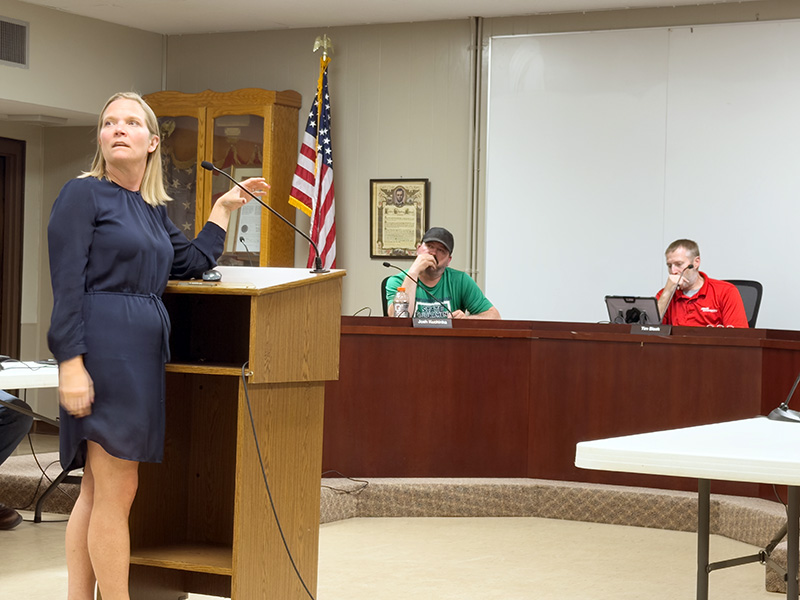
Two individuals stopped by to present further information to Montgomery’s Planning and Zoning Commission regular meeting, Nate Dorr and Breanne Kennedy. Dorr is the senior manager of Rural and Tribal Capacity Building Program for the Greater Minnesota Housing Fund (GMHF), and Kennedy is the owner and founder of Thrive Consulting.
Kennedy presented on removing barriers to housing development with a land use audit, which was carried out by the GMHF for free, valued at about $5,000.
“The idea was to provide a housing focused look at Montgomery’s land use and zoning to help inform the city’s comprehensive plan, look at potential sites for housing and give consideration to how city code is helping or hindering housing,” said Dorr. “In other communities where we’ve done this, the city council or planning commission went ahead and worked with their staff and attorneys to update codes (e.g. smaller lots, smaller side yards and set back, reduced parking requirements, increased density). Then some had hired another consultant to get into the weeds on the actual city code and resolution language.”
Dorr says the motive behind land use policy updates is to find ways to ensure developers have clarity on potential sites that can be developed and also to reduce overall development costs so people can afford the housing better.
One such thing Kennedy noted was that in some areas adjacent to business areas, lot sizes could be smaller than what the city’s code currently allows so a house could be built without a barrier of getting an exception.
The zoning audit showed that there is not enough vacant land available for demand, lot size and width don’t match existing development pattern, that there isn’t a clear allowance for modular building, that there are restrictive use districts, and that a mix of uses or multiple options for uses isn’t allowed within the city code.
“Just driving around and looking at your aerial maps, there are a few sites that we think could be good housing sites but currently not allowed in the zoning. So the property owner wouldn’t necessarily be looking for a housing developer for those vacant or underutilized sites because it’s zoned business,” said Kennedy. “You do want to be strategic about which sites, which zoning districts housing is allowed in.”
One such site that was identified that could be utilized as such are the two lots east of Dollar General along Milwaukee Avenue. Additionally, other lots adjacent to the city limits were also noted. In order for any housing to go forward on these sites, the owner has to also be willing to either build or work with a developer to sell the land for such a development.
Commission Vice President Pat Brockway brought up that he hasn’t seen the need for so many additional housing units here like the housing study by Maxfield Research completed for the city shows. Kennedy noted multiple reasons why there is increased demand for single and different housing, including divorce, seniors, and people not raising a family and buying housing later.
Maxfield’s study showed a need for about 712 housing units in the city by 2035, with 313 for sale, 95 for market rate rental, 186 affordable or subsidized rental, and an additional 118 service-enhanced for seniors out of that.
Commission member Paul Brown said, “I think an important thing to remember is that people aren’t having kids after high school anymore. They’re living in an apartment and then finding a house. A lot of people are like me. They’re single, in their 30’s, they’re finding their own house and then they’re having a family. At that point, you got to be able to have houses like someone like me can afford.”
This service provided by GMHF is at least some feedback for a direction to possibly explore further what the city can do to help attract and make possible more housing opportunities.
Read the full story from Montgomery Messenger.
Photo credit: Jarrod Schoenecker, Montgomery Messenger
 South Minneapolis Native American Clinic and Housing Set to Open in September