

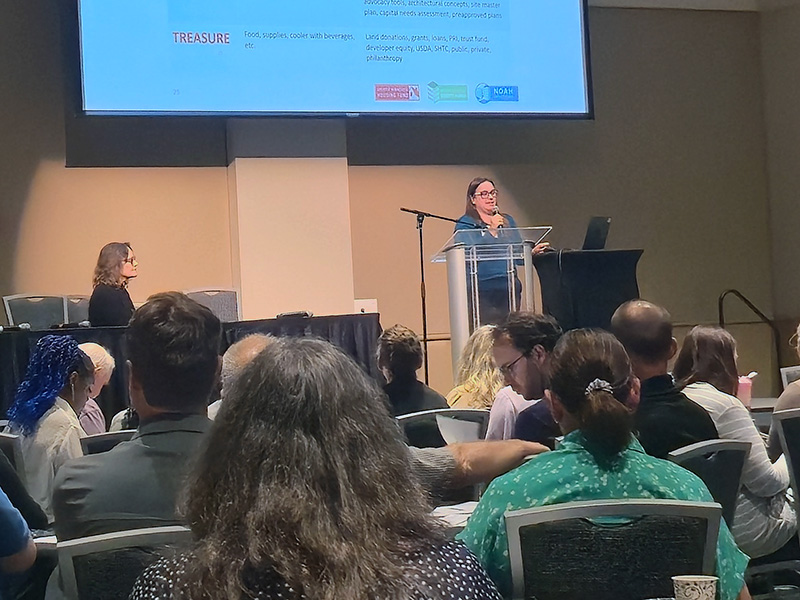
From start to finish, panelists and speakers at Wednesday’s daylong housing forum stressed the importance of collaboration in addressing affordable housing issues in south-central Minnesota.
“Housing is one of the most important issues throughout southern Minnesota,” said Alejandra Bejarano, economic recovery planner for the Region Nine Development Commission, as the forum opened at the Mayo Clinic Health System Event Center.
Region Nine, Minnesota Housing, Greater Minnesota Housing Fund, and Minnesota Housing Partnership sponsored the panels, joining regional housing leaders throughout a 12-county swath of southern Minnesota.
“Partnerships and collaboration is kind of the word of the day,” noted Andrea Brennan, CEO and president of the Greater Minnesota Housing Fund, who provided remarks on her agency’s 30-year history over the lunch break.
From the state, Minnesota Housing Deputy Commissioner Ryan Baumtrog noted the past legislative session provided strong support for programs “from homelessness to homeownership.”
“Housing remained an issue with strong bipartisan support,” he said.
An affordability gap for both developers and those looking for housing options weighed heavily on panelists throughout the day.
“Incomes are stagnating or even decreasing and we have home values (and rents) that are increasing,” said Jill Henricksen, community development manager for MHP, which researches housing costs and incomes throughout the region.
Together, those figures allow housing professionals to analyze the “cost burdens” to both homeowners and renters. The agency considers housing costs should not exceed 30% of total household income. Above 50%, it’s considered a “high cost burden.”
The state’s most recent housing figures show that throughout south-central Minnesota, 72.5% of the region’s nearly 70,000 housing units are owner-occupied, with 27.3% as renters. But that varies largely from county to county.
While MHP’s research shows that just 61% of housing units in Blue Earth County are owner-occupied, it’s as high as 81% in Le Sueur, Sibley and Waseca counties. State figures also show that the regional median price of houses is increasing, up 4% since 2024 to $260,000 and up nearly 21% from 2021.
For renters, the increases also have been rising.
“Rent levels are far outpacing income,” said Jennifer Prins, coordinator of River Valleys Continuum of Care, or CoC.
CoC receives funding from the U.S. Department of Housing and Urban Development, as well as sometimes leveraging some state and local funding partnerships. But Prins noted that uncertain federal funding levels and changing strategies are impacting programming and staffing concerns.
‘Unsheltered’ voices
During the “Community Voices, Community Solutions” portion of the forum, Mankato native Shameka (Meme) Simpson talked about her family’s personal dive into homelessness. But she praised programs such as The Reach Resource Center in Mankato, which opened in 2011 and has served over 5,000 youth ages 16-24, as well as homeless prevention services via Lutheran Social Service for helping her family back into housing after unsheltered time.
“Now, my sister owns her house,” Simpson said. “And now she’s giving back to the community.”
Devan Mortwedt, community resource coordinator for the city of Mankato, agreed that a key for addressing homeless resident needs in the community is about navigating resources with those who may not know or understand the system.
“Connecting these individuals to those resources is important, but bridging those barriers is even more important,” Mortwedt stressed. “We’re looking truly to where people are.”
Other local success stories include a planned 40-unit Popular Apartments in Mankato, a supportive housing initiative with “wrap-around services.” Trisha Anderson, executive director of Partners for Housing in Mankato, calls the plan a beautiful collaboration.
The project, which broke ground in March, is slated for completion in March 2027. It was the result of years of planning and collaborative partnerships, Anderson said. It’s designed for 14 studio apartments, 22 one-bedrooms and four two-bedroom apartments.
“This is a powerful collaboration in the work we do,” she said.
Mortwedt agreed: “Our community is seeing something that we’ve never seen before.”
Simpson joined others who stressed the importance of connections and for social service professionals that put their “boots on the ground” and connect “to the people who need the services.”
Still, for some — those who watched the U.S. Department of Homeland Security’s Operation Metro Surge — confrontations with ICE agents and the detainment and deportations of some residents made all issues difficult, said Lourdes Menjivar, regional director for the South Central MN COPAL organization.
“Every single day we’re looking for resources,” Menjivar said, adding immigration enforcement efforts hit Madelia, St. James, Sleepy Eye, St. Peter and Waseca.
‘Jump in’
For developers and communities hoping to expand their housing units, building costs are rising and infrastructure expenses even higher, said St. Peter City Administrator Todd Prafke. But the changing dynamics of housing development, he noted, mean communities and local governments need to take the lead, accepting some risks.
“That is a super hard thing to do,” he said about convincing city councils and other governmental units and their elected officials. “But housing is an economic development issue … Cities need to be creative about how they’re financing these projects.”
Prafke and his council have teamed up with Southwest Minnesota Housing Partnership and the CoNorth real estate development group to put together a cooperative manufactured home subdivision of 60 units.
Chad Adams, executive director of the Slayton-based community developer agency, agreed. His agency has teamed up with St. Peter on several projects, including the Solace apartments for individuals and family units in recovery efforts through court action.
“Be willing to disrupt the status quo and you don’t have to do it alone,” Adams said.
Read the full story from The Free Press.
Photo credit: Dana Melius, Special to the Free Press
 Rural and Tribal Capacity Building Program Helps Montgomery with Housing Needs