

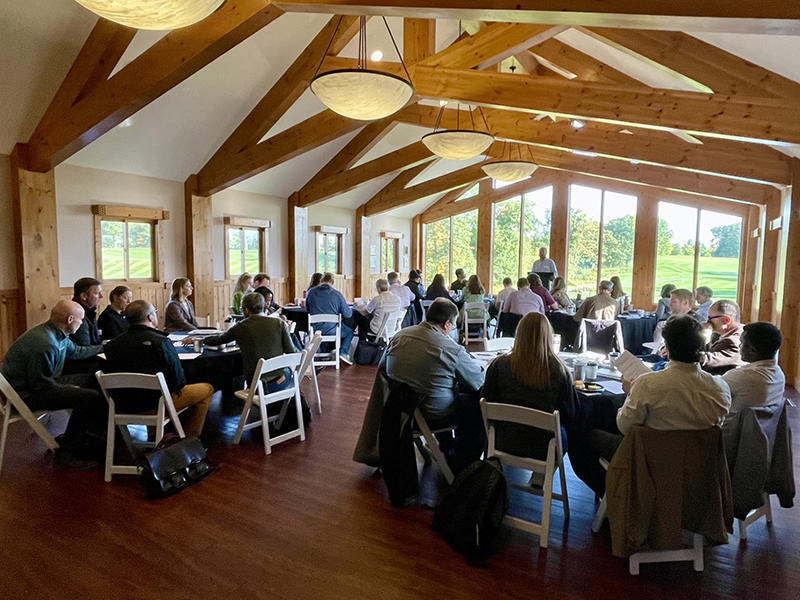
On October 1, GMHF brought together affordable housing developers, public agencies, lenders, funders, and energy experts in Brainerd for our second Energy Development Convening of 2026. We are focused on ensuring the benefits of the energy transition are realized in rural and Tribal communities, where there are both unique challenges and incredible opportunities to ensure greater autonomy, resilience, and health in Minnesotan’s homes.
The gathering was designed to move beyond a conversation about why energy efficiency and high-performance construction matter and focus instead on how projects can move forward. Participants explored the changing landscape of incentives and public resources, financing and technical assistance available to developers, and the practical challenges of incorporating technologies such as geothermal, solar, electrification, and higher-performing building envelopes into affordable housing.
Representatives from Minnesota Housing, the Minnesota Department of Commerce, and the Minnesota Climate Innovation Finance Authority helped set the stage with a discussion of Minnesota’s evolving policy, funding, and building-performance landscape. GMHF then shared more about its Energy Loan Fund, which provides flexible, concessionary financing and technical assistance to help affordable housing developers pursue higher levels of energy performance.
A central theme throughout the conversation was the importance of engaging early. Understanding incremental costs, available incentives, building-system options, and long-term operating considerations during predevelopment can help developers determine which strategies make sense for a particular project and reduce the risks associated with trying something new.
Just as important, the convening created space for developers and practitioners to talk candidly about what is working and where challenges remain. Participants discussed questions ranging from the cost and complexity of higher-performance construction to geothermal feasibility, heat pumps, solar, tax-credit considerations, operations and maintenance, and the technical expertise needed to successfully design and operate these buildings.
Project examples from across Minnesota brought those conversations to life, including work involving Itasca County Habitat for Humanity, the Lower Sioux Indian Community, Darcy Solutions, US Solar, Leech Lake Financial Services, and the HRA of Hibbing. Together, these examples demonstrated that there is no single pathway to higher-performing affordable housing. Different projects, communities, and developers will require different technologies, financing structures, and levels of support.
For GMHF, the convening reinforced that financing is only one piece of the puzzle. Advancing high-performance affordable housing will require developers, government, lenders, technical experts, utilities, and community partners to learn alongside one another and identify practical solutions that work in communities across Minnesota. Through the Energy Loan Fund and related technical assistance, GMHF is working with developers to reduce the financial and technical risks of innovation while creating safe, stable, affordable homes that are efficient, resilient, and sustainable for the long term.
 GMHF and Lower Sioux Indian Community Break Ground on Hempcrete Elder Home