

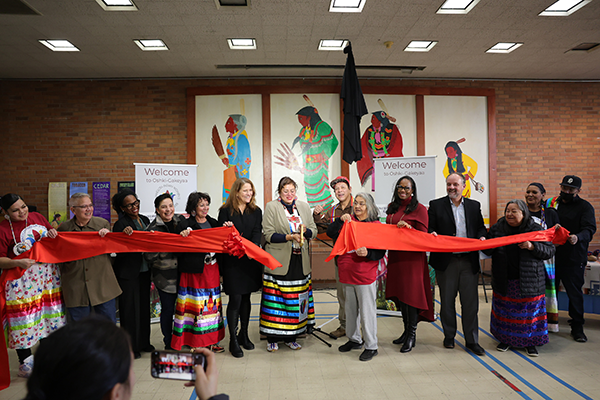
The Minnesota Indian Women’s Resource Center (MIWRC) celebrated the grand opening of Oshki-Gakeyaa (“Oh-sh-key-Gah-key-yah”), meaning “New Way” on November 13, 2025. The ribbon cutting brought together community leaders, partners, and residents to mark completion of a new 24-home permanent supportive housing community in the East Phillips and Ventura Village neighborhoods of Minneapolis — a significant achievement in strengthening housing stability and opportunity for Native families.
A Model of Stability, Partnership, and Independence
The Oshki-Gakeyaa community provides safe, newly renovated homes paired with practical, trauma informed support services designed to help individuals and families achieve lasting independence and wellness.
Twenty units are dedicated to single adults referred through coordinated entry, while four serve individuals with disabilities referred through MIWRC. The development combines effective case management and efficient use of resources to promote long-term success for residents and families.
“Today marks an important milestone for our community and for the families beginning a new chapter,” said Ruth Buffalo, CEO of MIWRC. “Every individual deserves the dignity of a safe home and the opportunity to live with purpose. Stable housing provides the foundation for families to grow stronger and more self-reliant.”
Public-Private Partnership Drives Results
The $14.1 million development was made possible through a coalition of public and private partners, including the City of Minneapolis, Hennepin County, Minnesota Housing, UnitedHealth Group, Minnesota Equity Fund (MEF), Greater Minnesota Housing Fund (GMHF), and Cinnaire.
UnitedHealth Group served as the largest private investor, contributing $9.4 million in tax credit equity administered through MEF, a strategic partnership between GMHF and Cinnaire.
“At UnitedHealth Group, we understand the importance of connecting housing and health to improve lives,” said Lisa Saul, M.D., chief medical officer, women’s health, UnitedHealthcare, part of UnitedHealth Group, which has invested nearly $87.5 million in Minnesota — and more than $1.2 billion across the country — to create and preserve affordable housing. “Oshki-Gakeyaa is an important example of our long-standing commitment to expanding access to safe, stable homes with supportive services, particularly for individuals and families with the greatest needs.”
“MIWRC is an indispensable resource for Native American women and families who need affordable housing with supportive services,” said Andrea Brennan, president & CEO, Greater Minnesota Housing Fund. “Our investment, in partnership with the Minnesota Equity Fund, Cinnaire, and UnitedHealth Group, ensures this development provides stability, safety, and dignity for residents while preserving culture and community strength.”
In addition to the tax credit equity, GMHF provided a $50,000 grant to MIWRC early on to support their role as an emerging developer of affordable housing as well as a $680,000 predevelopment loan to ensure they had the operating capital needed to get to the closing table. GMHF also provided a $4 million construction loan, thanks in part to a relationship with Allina Health through the Housing and Health Initiative.
Leaders Emphasize Community Strength and Shared Responsibility
According to a newly released report from Wilder, Native Americans experience homelessness at much higher rates than other group. The alarming over-representation of Native Americans experiencing homelessness is magnified within the unsheltered population.
“Oshki-Gakeyaa demonstrates what’s possible when communities work together toward shared goals,” said Minneapolis Mayor Jacob Frey. “This new development reflects the power of partnership and purpose, providing stability, hope, and opportunity for residents.”
Jennifer Ho, Commissioner, Minnesota Housing Finance Agency, added: “By combining state investment with local leadership and private investment, we’re helping more families secure affordable, stable, and community-led solutions that support success.”
Community, Tradition, and Renewal
The ribbon-cutting included a traditional prayer, blessing, and song, followed by tours of the new homes. To celebrate the newly moved-in residents, UnitedHealth Group volunteers joined MIWRC staff and partners to assemble and deliver welcome baskets filled with household essentials and healthy foods — symbolizing new beginnings, stability, and community care.
“Having the opportunity to work and live for MIWRC has changed my life for the better,” said Anthony LaBatte, a newly moved-in resident who helped cut the ribbon during the event. “Thank you all so much for giving me a life.”
A Proven Model for Long-Term Stability
For more than 40 years, MIWRC has served Native women and families through traditional values and effective community-led solutions that promote health, stability, and self-sufficiency.
Through this new development, MIWRC continues its mission to support individuals and families in achieving long-term stability through accountable partnerships, responsible resource management, and respect for cultural heritage.
MIWRC is partnering with Shelter Corporation for on-site property management and Hennepin County’s Streets to Housing Outreach team for coordinated entry assessments and service support.
Photo credit: Audrey Anderson
 Dreamliner Estates Celebrates Groundbreaking of Twin Home Project in St. Cloud