
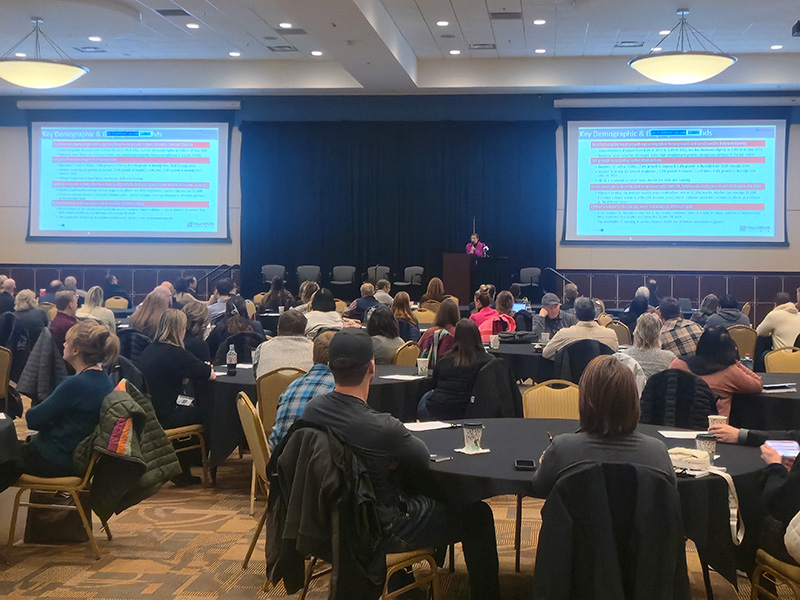
The Beltrami County Housing Roundtable on December 2 was more than a meeting — it was a call to action. Leaders from across the housing spectrum, including government officials, developers, bankers, tribal partners, and community advocates, came together to tackle one of the region’s most urgent challenges: creating sustainable, affordable housing for all.
The cornerstone of the event, co-sponsored by Greater Minnesota Housing Fund and Sanford Health of Northern Minnesota, was insights from the county-wide housing study. Mary Bujold, president of Maxfield Research, shared results from the recently conducted housing needs analysis, which revealed a demand for 4,179 general occupancy housing units from 2025 to 2035, which includes 2,085 senior units needed across Beltrami County by 2035.
“The rate of housing units being constructed in the area will not meet the growing demand if we keep doing what we are doing now,” said Nate Dorr, GMHF’s Rural and Tribal Capacity Building Manager. “We need a very focused effort by a multitude of partners to do business differently to meet our growing housing demands, preserve existing units, and keep housing affordable across the board.”
The area housing data shows room for landlords to increase rents, due in part to the area having a general occupancy rental rate of only 1.9%. This holds true even while household income growth lags far behind the steady rise in median home values. This leaves a larger gap between those who are renting but want to get into homeownership, with the median asking price in the county for a single-family home now at $342,450 and median new home construction pricing at $409,950.
“This missing middle housing issue should force us to consider higher density housing, multifamily, and townhome concepts to increase the supply of both rentals and affordable homeownership opportunities,” Dorr added.
The high level of need for housing was echoed by Rep. Spencer Igo, Co-Chair of the Minnesota House’s Housing Finance and Policy Committee.
“We’re talking about senior housing. We’re talking about multifamily housing. We’re talking about condos, townhomes, single family homes — all of it. The answer is we need to be building all of them,” shared Rep. Igo. “We need to do and create policy that’s going to inspire growth in all diverse types of housing. Because when we create diverse forms of housing, we create affordability in the marketplace.”
Throughout the sessions, the panelists were candid about the challenges of meeting these housing needs, specifically when it comes to financing and the need for public-private partnerships to make projects viable. Developers discussed collaborating with local employers to support more workforce housing. Representatives from local banks highlighted opportunities through their membership with the Federal Home Loan Bank that could offer additional financing options. Tribal housing authority staff from White Earth and Leech Lake shared how they are following the Red Lake Nation’s lead to create more homeownership opportunities on tribal lands.
Even with the challenging environment, the energy in the room was focused on solutions.
“We need to take collective action to move the needle on what we’re doing for housing in the region,” said Beltrami County Administrator Tom Barry. “Let’s all commit to one action — imagine the collective movement we could make. Together, we can build more than places to live.”
Housing is not just a challenge — it’s an opportunity to drive and support economic development in the region. By combining creativity, collaboration, and persistence, Beltrami County can build a future where everyone has a place to call home.
What’s Next? Turning Momentum into Action
The Housing Roundtable was just the beginning. Greater Minnesota Housing Fund is committed to moving the conversation to collaboration, and ultimately, construction. Here’s is what is on the horizon:
- Share the Housing Study Broadly: The county-wide housing needs analysis is completed and publicly available on the Beltrami County website, providing a roadmap for targeted development.
- Engage with Local Housing Collaboratives: Cross-sector groups of Beltrami County area stakeholders convene monthly to prioritize projects, identify funding sources, and share information. This and similar collaborative efforts offer opportunities for stakeholders to actively pursue housing solutions.
- Engage Employers and Community Partners: Workforce housing solutions need to work with local businesses, tribal partners, and public agencies to attract and retain talent.
- Expand Financing Options: Banks and developers can continue working with state, federal, nonprofit, and local programs to unlock new funding opportunities.
- Support Tribal Housing Initiatives: Collaboration with tribal housing authorities cannot be overlooked as we work to increase homeownership and rental options on and off tribal lands.
This is a pivotal moment for Beltrami County. By committing to these next steps, we can transform today’s housing challenges into tomorrow’s opportunities. Together, we can build more than homes. We can build a stronger community.
 GMHF Closes on Financing for Penn Station in Richfield